

⚠ CRITICAL — added to CISA KEV on Nov 18, 2026. CVE-2026-90817 is an unauthenticated remote code execution flaw in REDCap, the data-capture platform used by thousands of universities, hospitals and research institutes for surveys and clinical studies. CVSS 3.1: 9.8.
How it works
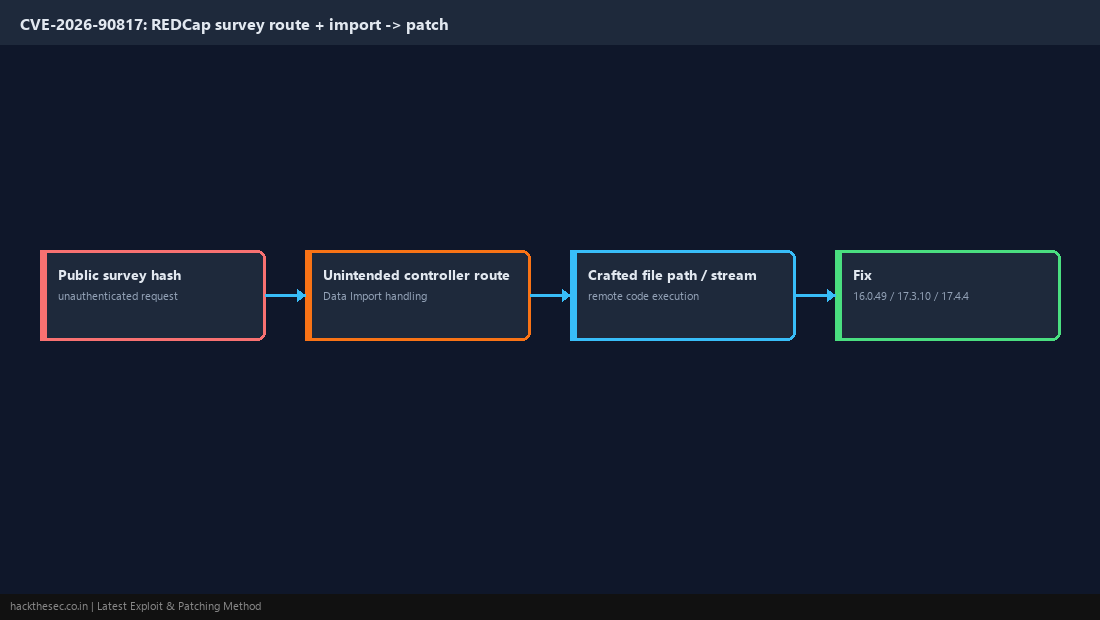
The flaw sits in REDCap's survey passthrough routing and Data Import processing. By manipulating HTTP requests from a public survey context, an attacker can reach a controller route that should not be reachable, and then supply a crafted file-path or stream parameter during import handling to run code on the server. No login is needed, only a valid public survey hash, which is in every public survey link.
Affected and fixed (per the NVD record)
- REDCap 13.3.0 up to before 16.0.49 (LTS) — upgrade to 16.0.49 or later
- REDCap 16.1.0 up to before 17.3.10 — upgrade to 17.3.10 or later
- REDCap 17.4.0 up to before 17.4.4 — upgrade to 17.4.4 or later
Patching Method
- Check your version on the REDCap Control Center home page.
- Download the fixed release from the REDCap Consortium community site (login required for consortium partners).
- Back up the database and the REDCap web directory, then use Control Center → Upgrade (or the upgrade script) to move to the fixed version.
- Confirm the new version in the Control Center after the upgrade.
Until patched, and after
- If you cannot upgrade immediately, temporarily disable public surveys or put REDCap behind VPN / institutional SSO.
- Review web server logs for unusual requests from survey URLs to non-survey routes and for Data Import activity you did not expect.
- Look for unexpected PHP files in the REDCap web directory and the temp/upload folders, and unusual processes running as the web server user.
- If compromise is suspected, rotate the database credentials in
database.phpand any API tokens, and review data exports.