

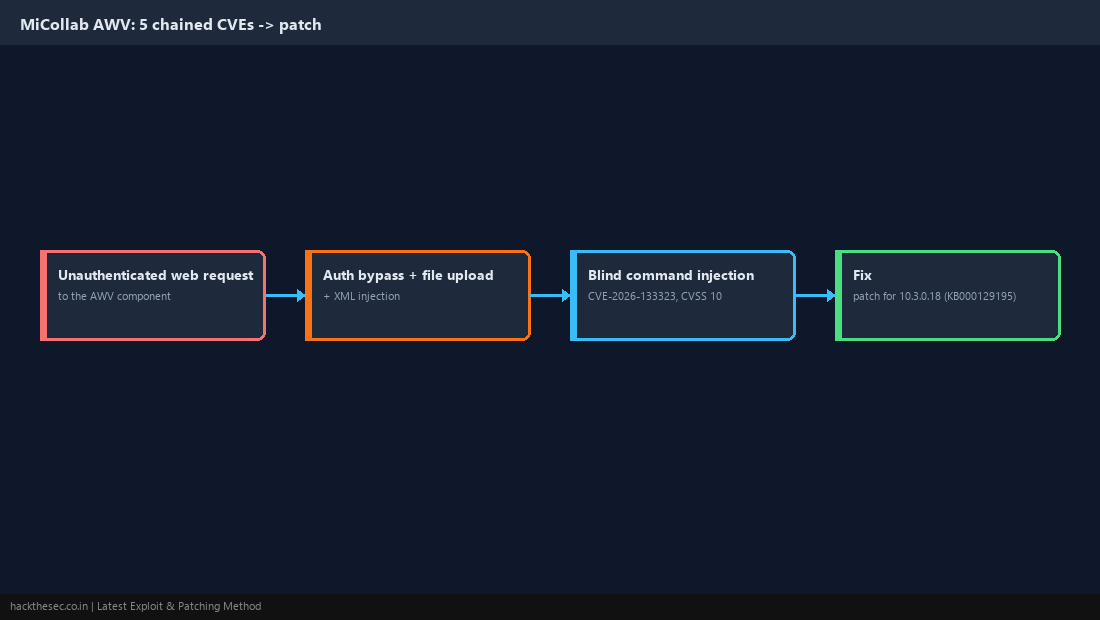
⚠ CRITICAL — all five CVEs added to CISA KEV on Nov 25, 2026. Mitel advisory MISA-2026-0012 covers five flaws in the Audio, Web and Video Conferencing (AWV) component of MiCollab 10.3 (10.3.0.18) and earlier. All of them can be triggered by an unauthenticated attacker, and Mitel notes that chaining them significantly increases the impact. A public analysis of MiCollab exploitation is linked from the CVE records.
The five CVEs
- CVE-2026-133323 — blind OS command injection (CVSS 10.0)
- CVE-2026-133303 — XML injection using pre-staged content, leading to command execution (CVSS 9.0)
- CVE-2026-133275 — arbitrary file upload (CVSS 5.3)
- CVE-2026-133324 — authentication bypass (CVSS 5.3)
- CVE-2026-133311 — improper authentication exposing sensitive information (CVSS 5.9)
Uploading a file, bypassing authentication and then injecting commands gives an attacker code execution on the MiCollab server, which usually sits at the network edge and connects to the phone system and directory.
Patching Method
- Confirm your version in the MiCollab Server Manager (Administration → Status). Anything at 10.3.0.18 or earlier is affected.
- Apply the security patch for MiCollab 10.3 (10.3.0.18) following Mitel knowledge article KB000129195, or upgrade to a later release.
- Restart the services as the KB instructs and recheck the version and patch level.
Until patched
- Restrict external access to the AWV component (Mitel's workaround). Allow only trusted networks or VPN users to reach the AWV web interface.
- Review the MiCollab server for unknown files in web directories and unexpected processes or outbound connections.
- If exploitation is suspected, rebuild the server from a clean image and rotate credentials stored on it.