

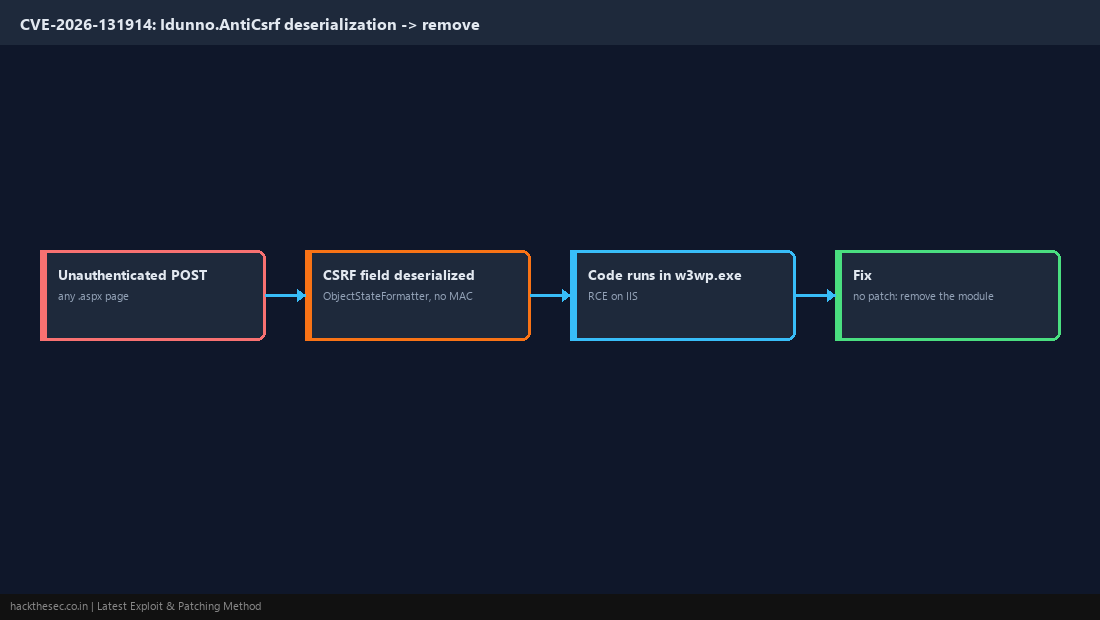
⚠ CRITICAL — added to CISA KEV on Nov 24, 2026. CVE-2026-131914 is a deserialization flaw in Idunno.AntiCsrf, an old ASP.NET anti-CSRF module (version 0.9.1 Beta, last built in 2008). An unauthenticated attacker gets remote code execution inside the IIS worker process with a single HTTP POST. Mandiant reports active exploitation in the wild. CVSS 3.1: 9.8; CVSS 4.0: 9.3.
How it works
The module's PreRequestHandlerExecute handler deserializes the CSRF form field with an unkeyed ObjectStateFormatter and no MAC or signature check. Any non-empty CSRF cookie plus a base64 gadget chain in the form field runs code in w3wp.exe. It fires before Page_Load, so even pages without a <form runat="server"> are exposed unless they opt out of the CSRF check.
There is no patch
The project is abandoned and has no maintainer, so no fix will be released. The only remedy is to remove the module and replace it.
Find it
# PowerShell on IIS servers
Get-ChildItem -Path C:\inetpub -Recurse -Include Idunno.AntiCsrf.dll -ErrorAction SilentlyContinue
Select-String -Path C:\inetpub\**\web.config -Pattern 'Idunno.AntiCsrf|csrfSettings' -ErrorAction SilentlyContinue
The official 0.9.1.0 DLL has SHA-256 da1efcfed182597ee946a9ef2895dfdfeab2bdff16855aeef01656d8158ead06.
Remediation (from Mandiant)
- Remove the
Idunno.AntiCsrfentries from<httpModules>/<modules>and thecsrfSettingssection inweb.config. - Delete
Idunno.AntiCsrf.dllfrom the application'sbin\folder and recycle the application pool. - Replace it with supported protection:
System.Web.Helpers.AntiForgery,ViewStateUserKeywith MAC-verified ViewState, or ASP.NET CoreIAntiforgery.
Check for compromise
- Review IIS logs for unusual POSTs to
.aspxpages that returned HTTP 302 or 500. - Look for unexpected files (web shells) in web roots and unusual child processes of
w3wp.exe. - If exploitation is suspected, rotate secrets in
web.configandapplicationHost.config: machineKey, encryption keys and database credentials.