
![[HIGH PRIORITY] Linux Kernel watch_queue Out-of-Bounds Write LPE (CVE-2022-0995)](https://lh3.googleusercontent.com/blogger_img_proxy/AEn0k_sdufUq_Sm547VwHuL4Er9GHEVAtXUQxgSM9F-pW0jS66OcbyM5EB4TcA6UueNSWGAxB5ubRjIzvEAN4PDds4mPF1Lrdl24XcpFGmsL7mILZ0VCfJE6sJhff54lDV_TLb8KFNvMQV3Zs5c2TTqGCX-YEBo4Nv2J9OId_gt3mHU)
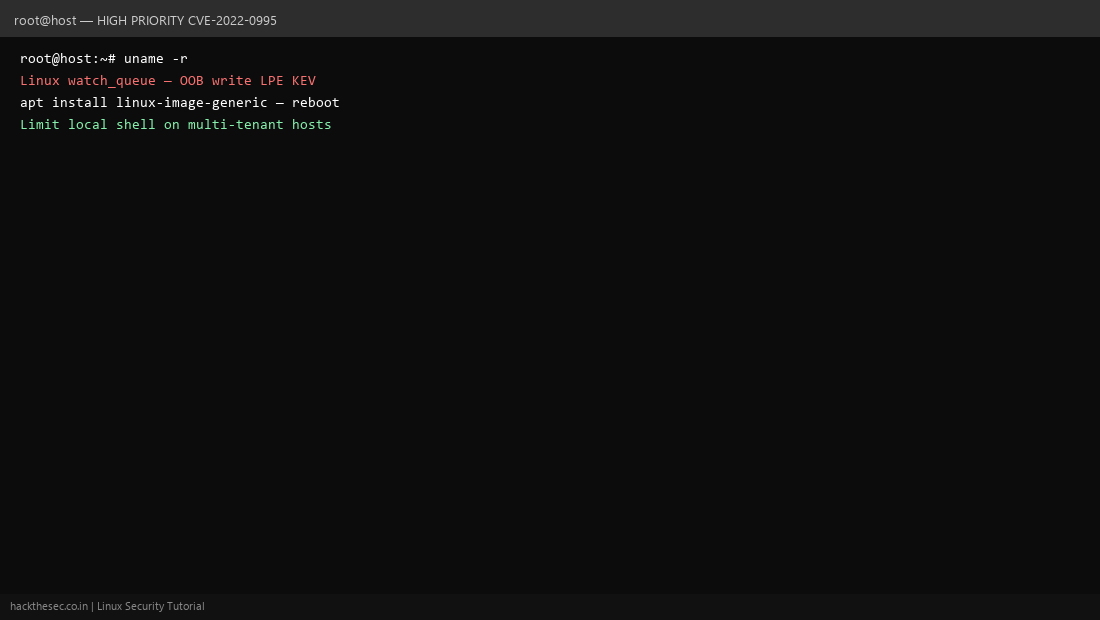
⚠ HIGH PRIORITY — CISA KEV (Aug 26, 2026). CVE-2022-0995 is an out-of-bounds write in the Linux kernel watch_queue subsystem. A local user escalates to root on unpatched kernels — public exploit code exists. Re-added to KEV due to continued active exploitation on outdated Linux servers.
Affected kernels
- Linux kernel before fix commit (mainline ~5.17, backports vary by distro)
- RHEL, Ubuntu, Debian, SUSE builds without CVE-2022-0995 backport
- Containers sharing vulnerable host kernel inherit the flaw
Verify patch level
uname -r
rpm -q kernel 2>/dev/null | tail -1
apt list --installed 2>/dev/null | grep linux-image | tail -3
grep watch_queue /proc/kallsyms 2>/dev/null | head -1
Patching Method
- Apply latest kernel security update from your Linux vendor (RHEL, Ubuntu, Debian, SUSE).
- On RHEL:
dnf update kernelthen reboot. - On Ubuntu/Debian:
apt install linux-image-genericthen reboot. - Reboot is mandatory — kernel patch is not live until restart.
- Verify new kernel with
uname -rafter reboot. - Limit local shell access on shared/multi-tenant Linux hosts.
- Audit for suspicious setuid binaries or cron jobs created by low-privilege users.
uname -r
needs-restarting -r 2>/dev/null || [ $(uname -r) = "$(rpm -q kernel --last | head -1 | awk '{print $1}' | sed 's/kernel-//')" ]
Until patched
- Restrict SSH/shell access to trusted admin accounts only
- Enable auditd for watch_queue-related syscalls if monitoring available
- Prioritize internet-facing Linux servers with user shell access
CVSS: 7.8 High. Local exploit — dangerous after any foothold.